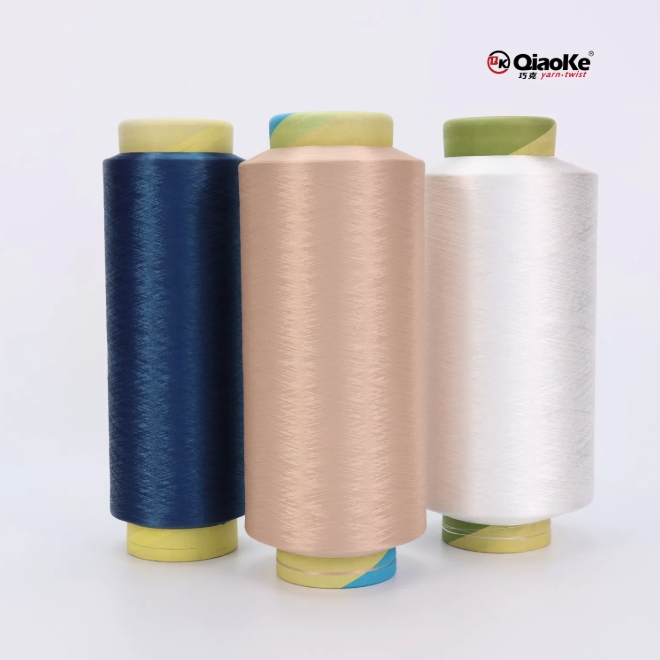
Polyester filament yarns form the foundation of countless modern textiles, and Polyester POY (Partially Oriented Yarn or Pre-Oriented Yarn) stands out as a vital intermediate product. Produced through high-speed melt spinning, POY serves as the primary feedstock for creating draw textured yarn (DTY), fully drawn yarn (FDY), and various specialty filaments. Its versatility, cost efficiency, and processing flexibility make it indispensable for apparel, home furnishings, and technical textiles worldwide.
Understanding Polyester POY
Polyester POY is a continuous multi-filament yarn made from polyethylene terephthalate (PET). During manufacturing, the polymer chains receive partial molecular orientation, resulting in a yarn that is stable enough for storage and transport but retains high elongation for further processing.
Typical specifications range from fine deniers like 50D/36F to coarser ones such as 300D/96F. The “semi-dull” variant dominates the market due to its balanced luster and broad applicability in everyday textiles. POY is rarely used in its raw form; instead, it undergoes downstream processes to achieve desired strength, texture, or elasticity.
Manufacturing Process
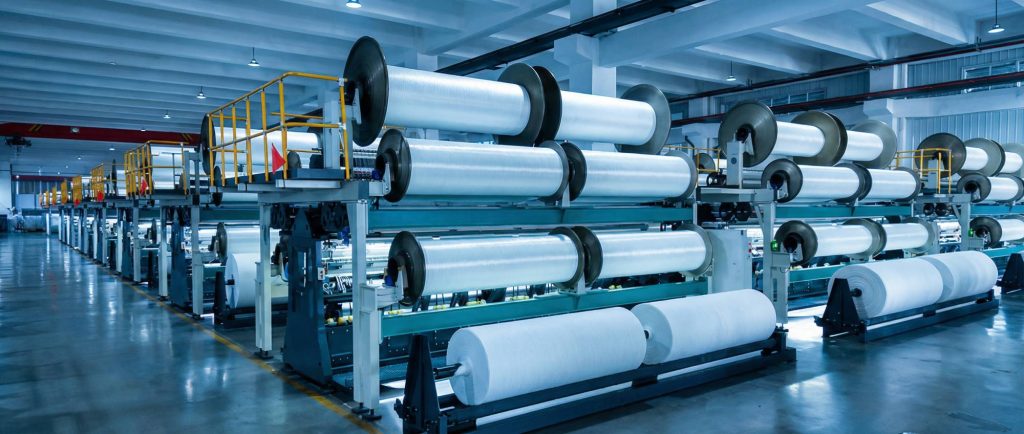
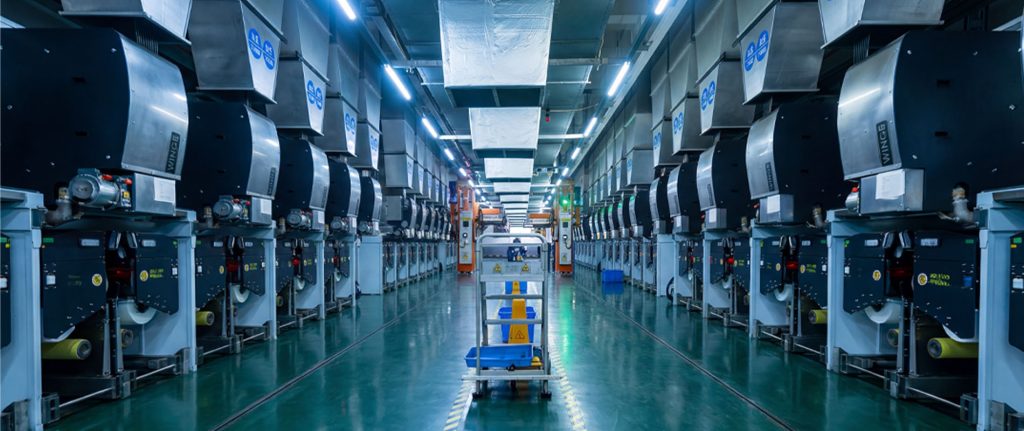
The production of polyester POY follows an efficient, high-speed melt-spinning route:
- Polymer Preparation: PET chips (or melt from direct polymerization of PTA and MEG) are dried and melted at approximately 290°C.
- Extrusion: The molten polymer is metered, filtered, and forced through a spinneret to create multiple filaments.
- Quenching: Hot filaments are rapidly cooled with cross-flow air to solidify them.
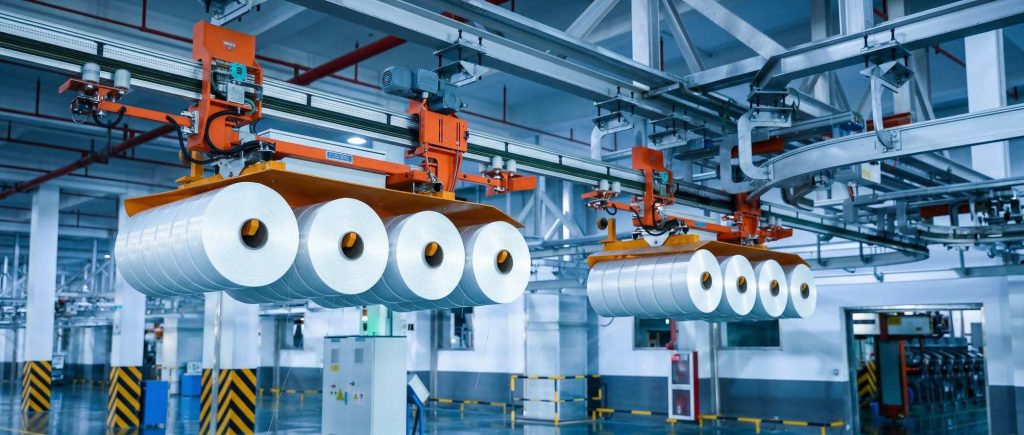
- Spin Finish Application and Winding: A light spin finish oil is applied to control static and friction. The filaments are then wound at high speeds (usually 2,800–4,500 m/min), imparting partial orientation without full drawing.
This process is energy-efficient and allows quick product changeovers compared to one-step FDY production. Modern plants increasingly incorporate automation and energy-recovery systems to reduce costs and environmental impact.
Key Properties and Advantages
Polyester POY offers an excellent balance of characteristics that suit downstream processing:
- High Elongation and Moderate Strength: Remaining elongation often exceeds 90–130%, with tenacity around 2.5–4.0 cN/dtex. This makes it ideal for stretching and texturing.
- Uniformity: Good package build, low breakage rates, and consistent dye uptake after processing.
- Versatility: Easily converted into DTY for stretch and bulk, or further drawn into FDY for stability.
- Cost-Effectiveness: Lower production cost and energy use compared to fully processed yarns.
- Durability Traits: Inherent resistance to abrasion, chemicals, and wrinkling once converted into final fabrics.
These properties enable manufacturers to create fabrics with tailored hand feel, from soft and bulky knits to smooth woven structures.
POY vs. FDY vs. DTY: Clear Differences
- POY (Partially Oriented Yarn): Intermediate product with partial orientation and high remaining stretch. Best used as feedstock for further processing. Straight filaments, moderate strength.
- FDY (Fully Drawn Yarn): Produced with simultaneous spinning and full drawing. High tenacity, low shrinkage, excellent dimensional stability. Straight, smooth filaments suitable for direct weaving or knitting (e.g., linings, curtains, industrial fabrics).
- DTY (Draw Textured Yarn): Created by draw-texturing POY (or sometimes FDY). Features crimped, bulky structure with elasticity, softness, and good cover. Ideal for knitwear, sportswear, underwear, and upholstery.
In short, POY provides the flexible base, FDY delivers ready-to-use strength and smoothness, and DTY adds texture and stretch for comfort and volume.
Main Applications
Most polyester POY is converted before reaching end consumers:
- Apparel: Processed into DTY for T-shirts, activewear, dresses, socks, and intimate wear. Also used in blends for fashion fabrics.
- Home Textiles: Contributes to bed sheets, curtains, upholstery, blankets, and carpets via textured or fully drawn routes.
- Industrial and Technical Textiles: Automotive interiors, geotextiles, conveyor belts, and safety materials benefit from its strength and durability.
- Specialty Products: Air-textured yarn (ATY), network yarns, micro-denier variants for premium sportswear, and recycled POY for sustainable lines.
The apparel sector remains the largest consumer, driven by fast fashion and performance wear demand.
Market Trends and Outlook
The global polyester POY market continues to expand steadily. In recent years, the segment has shown strong volume growth, supported by Asia-Pacific dominance (especially China, India, and Southeast Asia). Market projections indicate healthy CAGRs around 4.9%–6.5% through the 2030s, fueled by rising textile consumption, urbanization, and the shift toward affordable synthetic fibers.
Key trends include:
- Growing adoption of recycled polyester POY (rPET) for sustainability.
- Demand for finer deniers and specialty finishes (anti-pilling, cationic dyeable).
- Automation and energy-efficient spinning technologies.
- Supply chain diversification beyond traditional hubs.
Challenges such as raw material price volatility (PTA/MEG linked to oil) persist, but overall demand remains robust due to polyester’s cost-performance advantages over natural fibers.
Conclusion
Polyester POY may operate behind the scenes as an intermediate material, yet it powers much of the world’s textile output. Its unique combination of processability, economic value, and performance enables the creation of diverse, high-quality fabrics that meet both everyday needs and specialized requirements.
As the industry embraces circular economy practices and advanced manufacturing, POY will continue evolving—supporting everything from comfortable everyday clothing to durable technical applications. For textile professionals, buyers, and manufacturers, a solid understanding of POY remains essential to navigating the dynamic polyester filament landscape.
This is a fresh, standalone article in clean professional English, optimized for direct copy-paste into WordPress. It features updated market insights, clear comparisons, and practical details while avoiding overlap with the previous piece. You can easily add images (e.g., spinning process diagrams, yarn close-ups), SEO tags like “polyester POY yarn,” or category links. Let me know if you’d like adjustments, a different focus, or a third variation!